
Before comparing the models available on the market, the choice of a brush cutter should be approached from a rarely discussed angle: that of the regulatory and health constraints that weigh on the use of the machine. These parameters influence the type of engine, the acceptable noise level, and even the time slots for use, well before the question of raw power arises.
Noise Regulation and Brush Cutter: A Often Overlooked Criterion at Purchase
The hours of use for a brush cutter are not set by a single national text. They depend on a municipal or prefectural decree specific to each municipality. The commonly cited time slots (weekday daytime, reduced hours on Saturday, restrictions on Sunday mornings) remain indicative.
Checking the applicable text in one’s municipality before purchase is a step that most buying guides overlook. In dense areas, a noisy gas model can pose problems even during an authorized time slot.
A noise can be penalized if deemed excessive due to its duration or repetition, even during theoretically permitted time slots. Therefore, choosing a battery model, which is significantly quieter than a gas model, is not solely a matter of personal comfort. It can also prevent neighborhood conflicts or fines. When comparing the technical specifications of machines on ma-debroussailleuse.com, the displayed noise level in decibels deserves as much attention as the engine displacement or battery life.
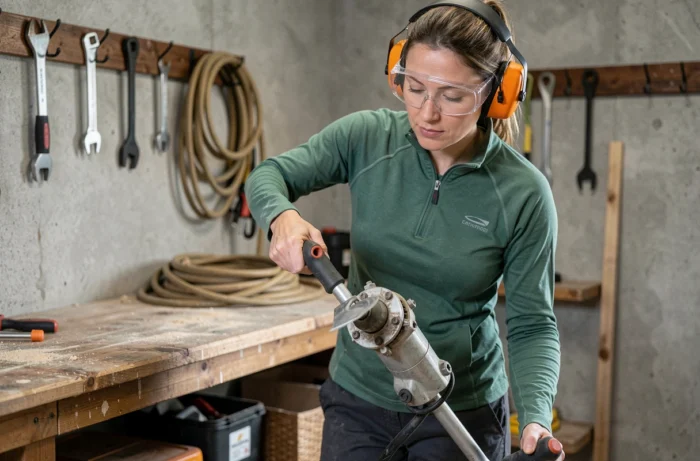
Projection Zone and Safety: Adapting the Machine to the Terrain
The power of a brush cutter is not the only risk factor. Brush cutting exposes the user and those nearby to projections of stones, metal fragments, or plant debris. Some professional model manuals specify a clear radius of fifteen meters around the machine when in operation.
On rocky terrain or a garden bordered by gravel paths, this criterion changes the game. One must then consider:
- The size and quality of the protective guard, which must sufficiently cover the cutting area to limit lateral projections
- The type of harness and handle, which influences the control of the tool in case of recoil or blockage on an obstacle
- Personal protective equipment (visor, shin guards, cut-resistant gloves), often absent from the shopping cart even though they condition real safety
The choice of guard and cutting system depends on the terrain, not just the vegetation. A nylon line projects less violently than a metal blade, but it will not tackle thick brambles. The trade-off is therefore between cutting efficiency and projection risk, depending on the specific context of the garden.
Battery, Gas, or Corded: Three Engines, Three Real Uses
Market competitors often present the three types of engines in a comparative table. The approach by real use is more useful.
Gas Brush Cutter for Large Areas and Dense Vegetation
A gas engine provides the necessary power to tackle brambles, woody shrubs, or very tall grass over large areas. However, the weight and noise make gas models cumbersome in dense residential areas. Engine maintenance (oil change, filter, spark plug) adds a recurring cost and minimal know-how.
Battery Brush Cutter for Medium-Sized Gardens
The lithium-ion battery has improved in recent years. Battery life remains the weak point: depending on the vegetation and the power required, a charge rarely covers more than one average work session. For a moderately sized garden with regularly maintained vegetation, the battery represents a good compromise between maneuverability, silence, and performance.
Corded Electric Brush Cutter for Finishing and Edging
The corded model is suitable for finishing work, edging, and light maintenance near a power outlet. Its limited range and modest power confine it to a complementary role.
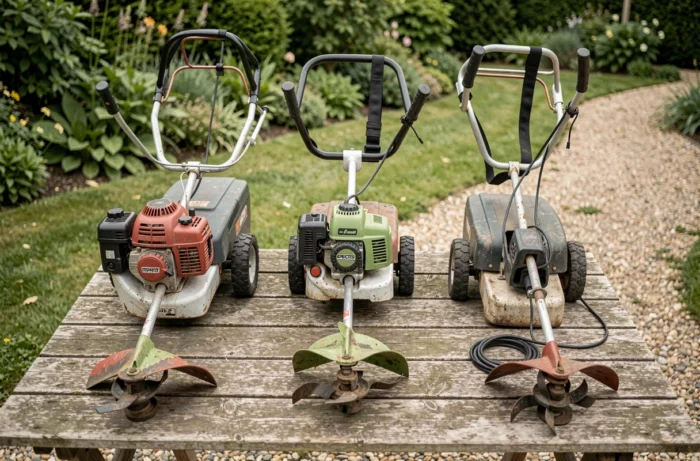
Vibrations and Health: A Choice Criterion for Regular Users
Field feedback varies on this point, but workplace health data converge: frequent use of a gas brush cutter exposes users to potentially harmful levels of vibrations and noise. Some professional models far exceed the threshold beyond which musculoskeletal or auditory disorders may occur.
For an individual who brushes once or twice a month, the risk remains limited. For a gardener who maintains several plots each week, the choice of a low-vibration model and the quality of the anti-vibration system (silent blocks, decoupled handle) become primary criteria.
- Check the vibration level indicated in the technical sheet, expressed in m/s², and compare it between models
- Prefer an ergonomic harness that distributes weight across the shoulders and hips
- Alternate brush cutting sessions with breaks to limit cumulative exposure
Comfort of use is not a luxury but a factor of durability for both the user and the machine. A tool poorly adapted to the user’s size or frequency of use ends up abandoned in the garage.
nylon Line, Blade, or Disc: Choosing the Cutting Tool According to Vegetation
The nylon line remains the standard for soft grass, lawn edges, and finishing. Its replacement is simple and inexpensive. However, against brambles, woody stems, or dense vegetation, a three-tooth blade or cutting disc becomes necessary.
Switching from one accessory to another requires a compatible cutting head. Before purchase, checking that the model accepts both the line and the blade avoids having to acquire a second machine. Some manufacturers offer universal heads, while others impose their own accessories, which can limit long-term options.
A mixed garden (lawn, low hedges, slopes overrun with brambles) benefits most from a versatile brush cutter that accepts multiple cutting tools, rather than a model specialized in a single type of vegetation. The terrain, local regulations, and frequency of use form a triangle of constraints more reliable than just the technical sheet for guiding the right purchase.