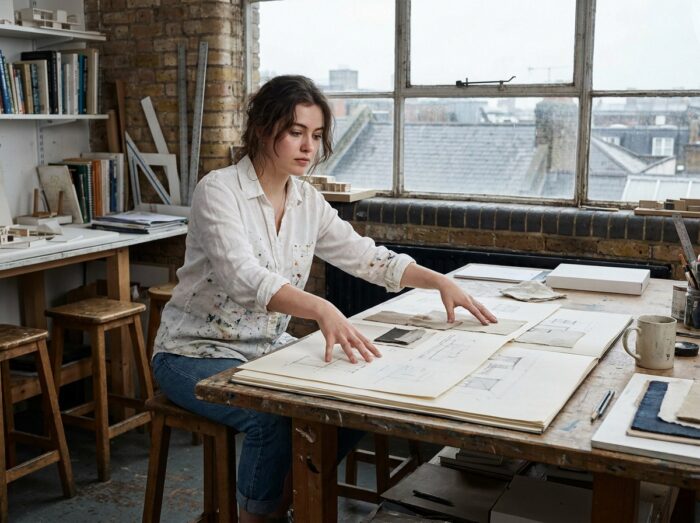
A post-bac candidate portfolio and a portfolio from a candidate who has gone through an art and design preparatory program do not look the same. The difference lies not in the number of pieces or in raw technical mastery, but in the structure of the visual discourse that the portfolio carries. The juries of higher art schools read a portfolio like a text: they look for intention, a thread, an ability to problematize a plastic subject. The preparatory program specifically transforms this dimension.
Post-preparatory portfolio: the readability of the artistic approach as a selection criterion
For several years, feedback from juries has converged on one point: portfolios from preparatory programs stand out due to a more readable and assertive artistic approach. The portfolio does not present itself as a succession of isolated works, but as a whole where each piece interacts with the others.
A direct post-bac candidate often presents a catalog of skills: a charcoal portrait, an Illustrator poster, a cardboard model. The candidate who has gone through a preparatory year shows a project that unfolds across multiple mediums with a clear statement of intent. The jury does not compare raw graphic quality; it evaluates the coherence of the argument.
We observe that this difference emerges as early as the first weeks of preparatory school, when teachers require students to articulate in writing what they are seeking before producing. This reflex of clarification, absent from most high school paths, restructures how the student selects and organizes their work in their portfolio. To better understand what an art and design preparatory program changes in the subsequent journey, it is this shift towards a constructed discourse that must be examined as a priority.
Documenting the creative process: the increasing demand in competitions
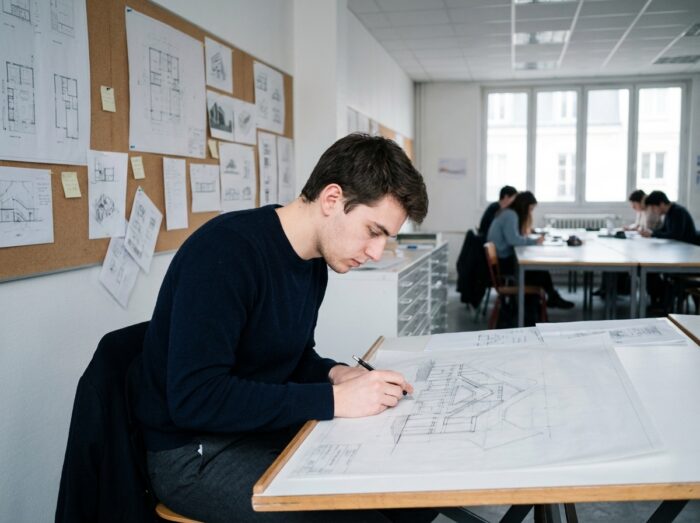
The admission guidelines published by several schools between 2024 and 2026 mark a clear evolution. Juries now explicitly request to see the candidate’s critical journey, not just the finished pieces. Preliminary sketches, abandoned ideas, successive iterations, marginal notes: all this raw material becomes a full-fledged evaluation criterion.
A portfolio consisting solely of polished renders, no matter how refined, sends a signal of methodological fragility. The jury wonders if the candidate knows how to bounce back from failure, modify a stance, or reformulate a plastic problem along the way.
What the preparatory program concretely changes in archiving the process
In the preparatory year, production is intensive and framed by regular verbalization sessions (group exhibitions, individual interviews, mandatory research notebooks). This structure forces the student to retain and organize their intermediate steps. The research notebook becomes a selection tool for the final portfolio.
Without this framework, a self-taught high school student often produces just as much but discards or forgets the phases of trial and error. When it comes time to compile the portfolio, they only have the results, not the journey that led to them. The preparatory program does not make one more creative, but it makes the creative process visible and usable.
- The research notebook shows the jury the ability to formulate plastic hypotheses before producing, which distinguishes a project from a stylistic exercise.
- Documented iterations prove that the candidate knows how to evaluate and correct their own work, a central skill in higher education.
- Written statements of intent, often required in preparatory programs, allow each project in the portfolio to be accompanied by a short text that guides the jury’s reading.
Crossed mediums and visual culture: what direct post-bac portfolios lack
A monodisciplinary portfolio is a handicap in most higher education competitions. Post-bac programs in art and design expect an ability to navigate between drawing, volume, photography, video, publishing, and installation. The preparatory program imposes this transversality through its curriculum: a student who enters in September with an exclusive practice of manga drawing leaves with experiments in screen printing, spatial modeling, and typography.
This openness does not aim for superficial versatility. It serves to show the jury that the candidate can engage with an unknown medium, understand its specific constraints, and integrate it into an approach. Design schools, in particular, seek this plasticity because their curricula are based on multidisciplinary workshops from the first year.
Artistic culture and references in the portfolio
The preparatory program also establishes a foundation of visual culture that is reflected in the portfolio. A candidate capable of situating their work in relation to specific references (artists, movements, designers) shows that they do not produce in a contextual void. Juries immediately spot a portfolio without cultural grounding, even if the graphic quality is present.
We recommend including at least one page in the portfolio that explains the references used for a given project. This gesture, systematically worked on in preparatory programs, remains rare among candidates who present themselves without a preparatory year.
Selection and layout of the portfolio: the mistakes that the preparatory program corrects
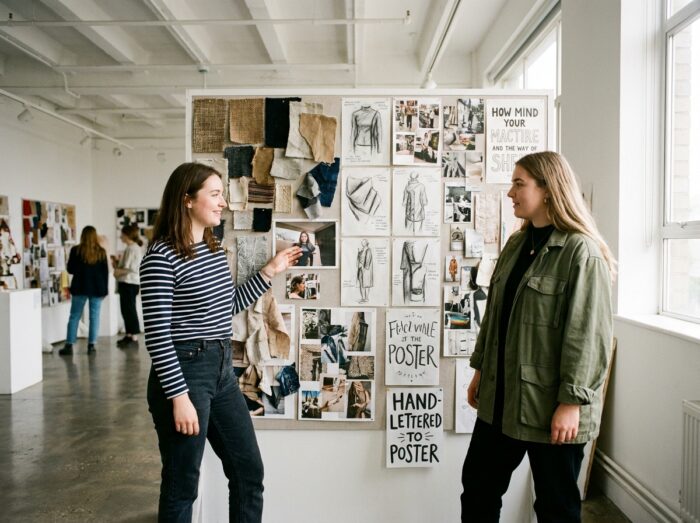
The layout of a portfolio is not a decorative issue. The order of projects, the rhythm between long and short pieces, the choice of what is shown and what is omitted: all of this constitutes an editorial discourse. In preparatory programs, students go through several guided portfolio reviews, where a teacher challenges each inclusion choice.
- Too many pieces kill the reading: a thirty-page portfolio dilutes the jury’s attention, which rarely spends more than a few minutes per file. The preparatory program teaches how to select eight to twelve projects and to embrace cuts.
- The absence of visual hierarchy (all images in the same format, without variation in framing) produces a catalog effect. Layout workshops in preparatory programs correct this reflex.
- The opening project of the portfolio must grab attention, and the closing project must leave a mark. This dramaturgy of the portfolio is rarely mastered by a candidate who has never received structured external feedback on their file.
The art and design preparatory program after the bac does not guarantee admission to higher education. It transforms the very nature of the portfolio, shifting the focus from graphic performance to the coherence of the argument and the documentation of the process. For a jury, this shift makes the difference between a candidate who draws well and a candidate who thinks about their work.