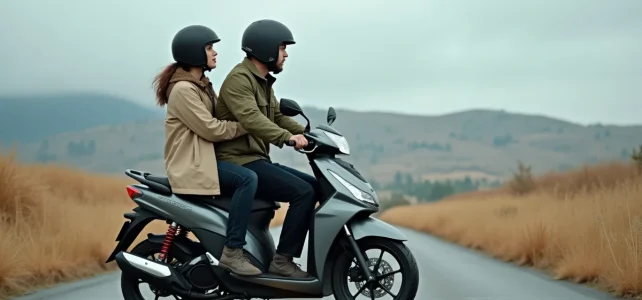
The Benda 125 catches the eye with its stout bobber look and its low price in the accessible custom segment for A1 license holders. The question of riding two-up often comes up in forums and owner groups: can you really carry a passenger on such a compact motorcycle, designed primarily as a style object?
Short chassis and two-up payload: what the bobber format implies
The Benda 125, whether it’s the Rock or the Napoléon, features a reduced wheelbase typical of bobbers. This aesthetic choice shortens the distance between the rear wheel axle and the steering column, which enhances maneuverability in the city but limits the usable seat area for two.
On this type of chassis, the passenger seat is often an optional accessory, rarely designed for long trips. The reduced seating area places the passenger very close to the rider, which alters the weight distribution towards the rear. With two, the center of gravity rises and shifts back, putting more strain on the rear suspension and tire.
User feedback from motorcycle communities confirms this reality: models with longer and more touring-oriented chassis maintain their stability better when carrying a passenger than the very short 125 bobbers. On the Benda, stability noticeably degrades as soon as the passenger exceeds a certain size. Discussions among owners mention a handlebar that feels lighter at the front and a tendency to weave during acceleration.
For those who want to delve deeper into the analysis of this model in real conditions, you can discover Auto l’Hebdo online where the issue of riding two-up is discussed in detail.
Benda 125 suspension and braking: the limits under load
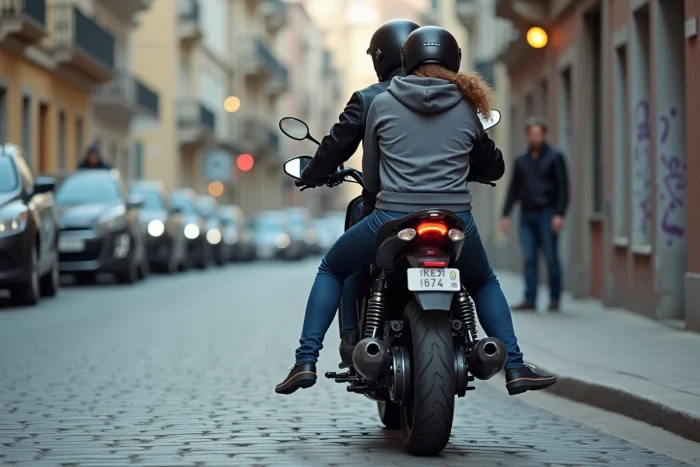
The suspension system is the first to feel the strain when riding two-up. The front fork, calibrated for a solo rider of average size, maintains acceptable travel. However, the rear shock absorber, often a single pre-set shock in this price segment, reaches its limit more quickly with the added weight of a passenger.
This compression of the rear suspension has cascading consequences:
- The motorcycle’s stance tilts backward, which lightens the front wheel and reduces steering precision.
- The residual travel decreases, making every road irregularity more noticeable for the passenger.
- The rear braking loses its smoothness because the chassis geometry changes under load.
The ABS braking system, present on recent versions, provides a valuable basic safety feature. The ABS partially compensates for the risk of rear wheel lock-up under load. However, the overall braking power remains calibrated for solo use on a modest displacement. When riding two-up downhill or during emergency braking, stopping distances increase significantly.
Rear preload: a setting not to be overlooked
Some owners recommend increasing the preload of the rear shock before riding two-up. On the Benda 125, this operation is straightforward (using a knob or a spanner), but it allows for a more balanced stance. Without this adjustment, the motorcycle dives at the front during braking and the passenger slides towards the rider.
125 engine and power when two-up: the weight-performance ratio
A 125cc single-cylinder engine, cooled by air or liquid (depending on the version), delivers a contained power, compliant with A1 license restrictions. When solo, the acceleration remains adequate in the city and on flat highways.
When riding two-up, the total weight increases significantly. The engine must then compensate with lower gear ratios, resulting in a higher RPM during cruising and increased fuel consumption. Acceleration uphill becomes laborious, and the comfortable cruising speed for two drops significantly compared to solo use.
Field feedback varies on this point: some users find the engine sufficient for short urban trips with two, while others consider the motorcycle underpowered as soon as a steady pace is needed on the road. Tolerance greatly depends on the combined weight of the rider and passenger and the type of route.
Benda 125 two-up on the road: for what practical use?
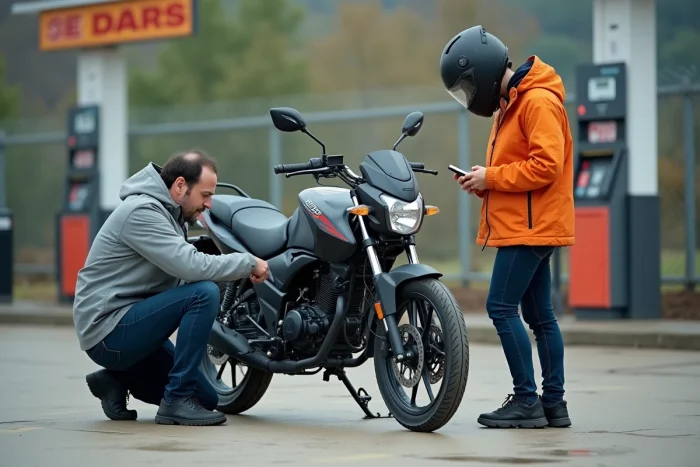
The question is not whether the Benda 125 can ride two-up, as it has the required equipment (passenger footpegs, grab handles on some versions). The real question concerns the duration and type of journey planned.
For occasional city use, over short distances and at moderate speeds, riding two-up is feasible. The sporty look and compact size make the motorcycle agile in traffic, even when loaded. The bobber style does not prevent carrying a passenger for a few kilometers.
For road outings lasting more than thirty minutes, comfort deteriorates quickly. The narrow passenger seat, the lack of a backrest, the limited rear suspension, and the lack of power during acceleration turn the journey into an endurance exercise for both occupants.
- Urban two-up: feasible, provided the preload is adjusted and short trips are undertaken.
- Two-up on roads or highways: not recommended beyond short distances, especially with two standard adult sizes.
- Two-up on highways: to be avoided, as power reserve and stability are lacking.
The Benda 125 remains primarily a solo motorcycle dressed as a custom, whose two-up capacity is more about regulatory compliance than a true two-seater vocation. Buyers planning to ride regularly with a passenger would do well to consider a longer chassis or a larger displacement.
The attractive price of the Benda 125 and its sleek black look are appealing on paper, but the experience of riding two-up tells a different story.