
Most aspiring interior designers are unaware that a degree is no longer enough to secure a place in the market. Employers and clients are now looking for hybrid skills that go far beyond simple technical drawing or aesthetic sense.
Amid forgotten certifications and atypical paths, some profiles manage to stand out where the majority stagnate. Salary gaps reflect a strict selection process: only the most versatile and connected are able to succeed.
The profession of interior designer: missions, responsibilities, and prospects
The daily life of an interior designer is not limited to drawing plans or choosing colors. One must juggle constraints, listen to clients, and translate sometimes vague expectations into concrete solutions. This profession, at the crossroads of architecture, design, and organization of spaces, requires solid agility.
An interior architecture project begins well before the first sketch. Fine analysis of needs, feasibility study, custom design, then budget management, coordination of all stakeholders, site monitoring… The professional touches on everything, from technical details to material choices, up to the final enhancement of the space.
Graphical representation quickly becomes essential: plans, sketches, 3D models, realistic renderings serve both to convince the client and to guide each step of the project. But it is not enough to master the software. Knowing how to anticipate uses, identify what will make a difference, and invent innovative solutions in the design of a product space: this is what distinguishes sought-after profiles.
Expectations are evolving rapidly, everywhere in France, including Paris, Marseille, Nantes, Toulouse. Flexibility, attention to sustainability, and adaptation to new lifestyles are becoming the norm. Those who remain fixed on their achievements see opportunities slip away.
In this context, standing out through training in interior architecture becomes a real lever. It is the ability to mix technical and artistic skills, relational ease, and a culture of design that opens the doors to various fields of interior architecture:
- management of complex projects,
- advice on decoration and space design,
- enhancement of built heritage,
- innovation in workspaces or housing.
The diversity of missions is appealing, but succeeding requires being rigorous, creative, and ready to evolve constantly in a demanding and unstable market.
Which training programs to choose to embark on or improve in interior architecture?
Choosing a training program in interior architecture is not a decision to be taken lightly. The choice is strategic: each program, each teaching method, each career path deserves to be scrutinized. Alternating programs attract because they allow immersion in the concrete: immersion in companies, management of real projects, direct confrontation with field realities. Theoretical teaching, on the other hand, structures the foundations: history of design, construction techniques, digital technologies, not to mention trend analysis.
A key point: the level of official recognition, with registration in the national directory of professional certifications (RNCP). This guarantee of seriousness reflects the quality of the content and its coherence with industry expectations, while offering a measurable employment rate. The best training programs are designed with professionals, led by instructors who know the field and its demands. Their experience enriches teaching grounded in reality.
| Type of training | Advantage |
|---|---|
| Alternating | Immediate professional experience, network in companies |
| Initial training | Acquisition of solid theoretical and technical foundations |
The most effective programs naturally integrate project management, usage analysis, design culture, and constant monitoring of material innovations. In Bordeaux, Lille, Lyon, or elsewhere, institutions that combine practice and theory produce agile profiles, ready to engage with all stakeholders in an interior architecture project.
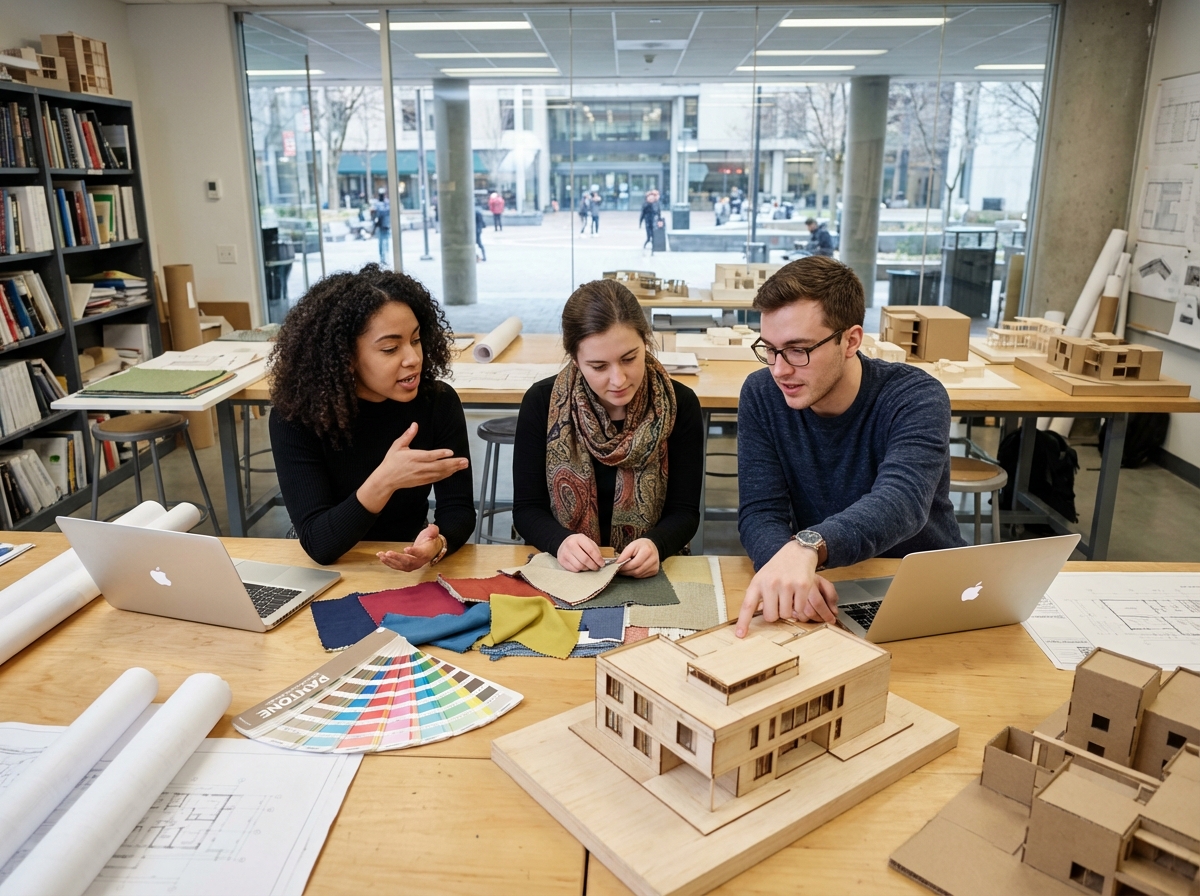
Standing out: concrete tips to boost your career and attract the right clients
It is impossible to overlook visual communication to establish oneself in interior architecture. A well-constructed portfolio, a coherent graphic identity: this is what inspires confidence from the very first contact. Taking the time to select your most impactful projects is not a luxury; it is a necessity. 3D views, precise plans, photos of concrete achievements: every visual counts.
Here are some levers to activate for effective positioning:
- Develop a strong digital presence: clear website, professional social networks, with a tone suited to the target clientele.
- Engage with the industry: trade shows, events, key moments to expand your network and meet partners.
- Enhance the representation of your skills, emphasizing the ability to manage a project from start to finish, from idea to realization.
The core of the profession remains active listening, a sharp understanding of client needs, and the ability to defend a vision while remaining open. Experience in a company makes a difference, especially when accompanied by regular monitoring of developments in graphic design and usage. Building an offer that combines technical demands and creativity transforms each project into a living business card. As for reputation, it is shaped on the ground, fueled by client feedback and controlled visibility on Google. Those who know how to combine these levers do not just exist: they assert themselves, simply.